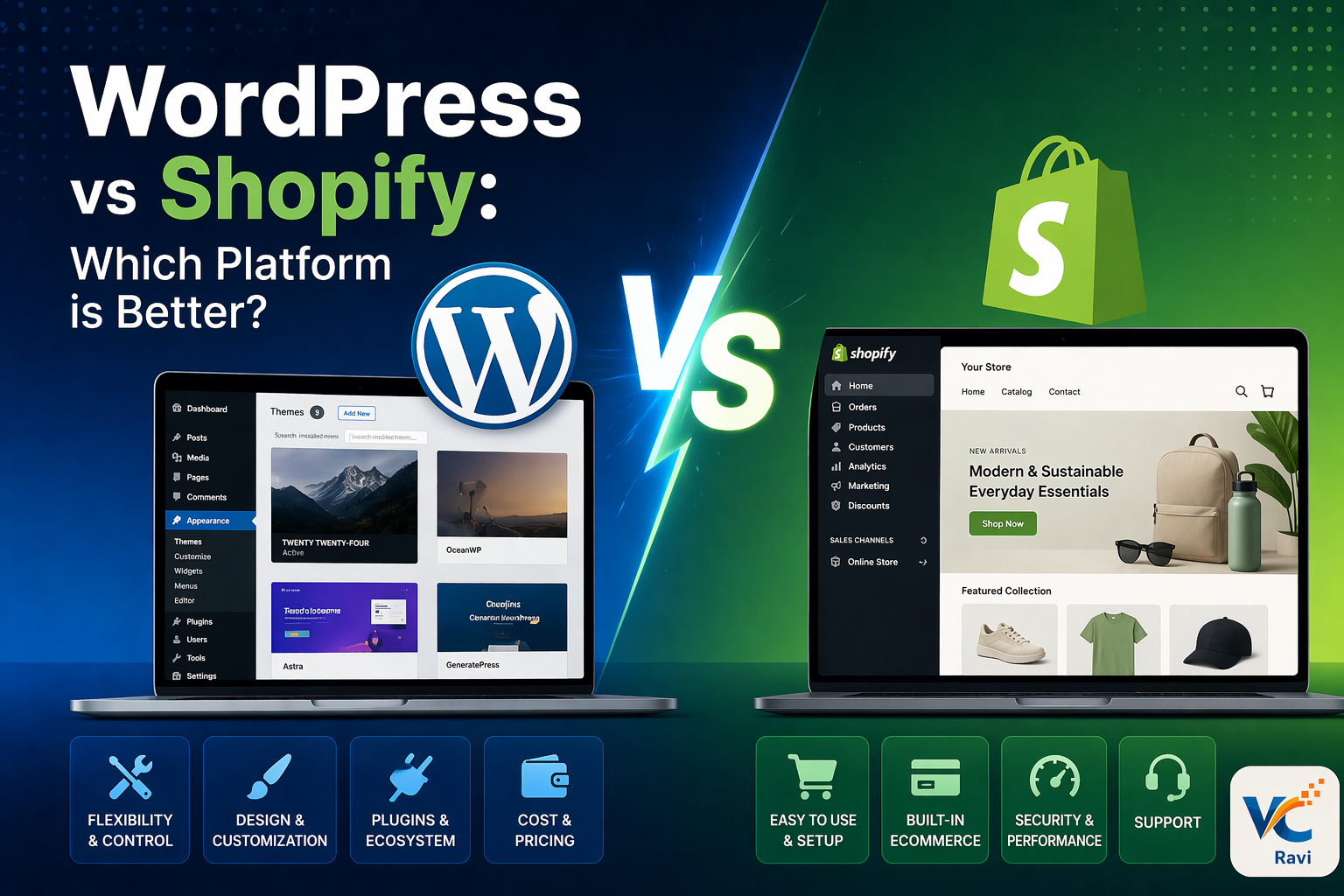
WordPress vs Shopify is one of the most common comparisons for business owners who want to build a website or online store. Both platforms are popular, reliable, and widely used, but they are built for different purposes. Understanding the differences in WordPress vs Shopify can help you make an informed choice.
Some people want a website with complete flexibility, better SEO, and full control over every detail. Others want a platform that is simple, quick to set up, and designed mainly for selling products online.
If you are confused between WordPress and Shopify, this detailed comparison will help you understand which platform is the better choice for your business.
As we dive deeper into the comparison of WordPress vs Shopify, consider your specific business needs and what each platform offers.
Understanding WordPress
WordPress is the most widely used website platform in the world. It is an open-source content management system that allows users to create almost any type of website, including blogs, business websites, portfolios, news sites, and eCommerce stores.
In the debate of WordPress vs Shopify, it’s essential to evaluate the scalability each platform provides.
One of the biggest advantages of WordPress is flexibility. You can customize almost every part of your website, from design and layout to functionality and SEO settings. If you want to sell products online, you can easily turn your WordPress website into an online store using WooCommerce.
WordPress is a strong option for businesses that want long-term growth, complete ownership, and more control over their website.
Many businesses prefer the flexibility of WordPress vs Shopify for building a unique online presence.
Understanding Shopify
Shopify is a hosted eCommerce platform built mainly for online stores. It is designed for people who want to sell products online without worrying about technical work such as hosting, security, updates, or maintenance.
When comparing WordPress vs Shopify, take note of how each platform handles payment processing and security.
With Shopify, you can create a store, upload products, accept payments, and start selling in a very short time. The platform includes built-in tools for inventory management, payment processing, shipping, and order tracking.
Shopify is often the preferred choice for beginners because it is easy to use and does not require much technical knowledge.
Main Difference Between WordPress and Shopify
Evaluating the user experience is crucial in the WordPress vs Shopify discourse.
The biggest difference is that WordPress is a flexible website-building platform, while Shopify is a dedicated online store platform.
WordPress can be used for almost any type of website and gives you complete control. Shopify focuses mainly on eCommerce and provides an all-in-one solution for online selling.
If your main goal is to create a content-rich website with blogging and SEO, WordPress is usually better. If your main goal is to launch an online store quickly, Shopify may be the better option.
Ultimately, the choice between WordPress vs Shopify comes down to your business model and growth objectives.
Ease of Use
Shopify is easier for beginners. The platform is designed in a way that allows users to set up a store quickly without much effort. Hosting, security, and updates are already included, so you do not need to manage them separately.
WordPress has a slightly steeper learning curve. You need to choose hosting, install themes and plugins, and handle updates on your own. However, once you understand how WordPress works, it becomes much easier to manage.
For someone with no technical knowledge, Shopify is generally simpler. For someone who wants more flexibility, WordPress is worth learning.
Design and Customization
Both platforms offer unique design capabilities, and weighing the pros and cons of WordPress vs Shopify is vital.
WordPress is much stronger when it comes to design and customization. There are thousands of themes and plugins available, making it possible to create almost any type of website design.
You can use tools like Elementor and WPBakery Page Builder to design custom pages without coding. Whether you want a simple business website or a large custom platform, WordPress gives you more creative freedom.
Shopify also offers themes and customization options, but it is more limited compared to WordPress. Advanced design changes often require editing Shopify code.
If design flexibility is important for your business, WordPress is the better choice.
eCommerce Features
Shopify is built specifically for eCommerce, so it includes many important features from the beginning. These include inventory management, product pages, payment gateways, discount codes, shipping settings, abandoned cart recovery, and order tracking.
WordPress can also provide strong eCommerce features through WooCommerce, but you may need extra plugins for advanced features.
For eCommerce solutions, understanding the strengths of WordPress vs Shopify can guide your decision.
For businesses that want an easy and ready-to-use online store, Shopify has an advantage. For businesses that want more control and customization, WordPress with WooCommerce can be more powerful.
SEO Comparison
SEO is one of the most important factors when choosing a website platform.
SEO tactics are another important factor to consider in the WordPress vs Shopify debate.
WordPress is usually considered better for SEO because it gives you complete control over URLs, meta titles, meta descriptions, headings, schema markup, internal linking, and image optimization.
Plugins like Rank Math and Yoast SEO make it easier to optimize content and improve search rankings.
Shopify has decent SEO features, but there are some limitations, especially when it comes to URL structure and advanced customization.
If you want to grow your website through blogs, organic traffic, and search engine rankings, WordPress is the better platform.
Blogging Features
In the world of content creation, the choice between WordPress vs Shopify can make a significant difference.
WordPress started as a blogging platform, which is why it is much stronger for content creation.
You can easily create categories, tags, author pages, blog archives, and custom blog layouts. This makes WordPress ideal for businesses that want to publish regular blog content and improve SEO.
Shopify also includes blogging features, but they are basic compared to WordPress.
If content marketing is an important part of your strategy, WordPress is the better option.
Pricing Comparison
When it comes to pricing, the differences between WordPress vs Shopify are substantial.
WordPress itself is free, but you still need to pay for hosting, domain registration, premium themes, plugins, and sometimes developer support.
Shopify works on a monthly subscription model. Hosting and security are included, but premium themes and apps can increase the overall cost.
For small businesses, WordPress can be more affordable in the long run. Shopify is easier to budget because you pay a fixed monthly amount.
Security and Maintenance
Shopify handles security, updates, hosting, SSL certificates, and backups automatically. This makes it a low-maintenance platform.
With WordPress, you are responsible for updating plugins, themes, and website security. You may also need backup plugins and security tools.
If you want a platform that requires less maintenance, Shopify is a better choice.
Payment Options
Both WordPress and Shopify support multiple payment methods.
The payment options in WordPress vs Shopify can affect your overall sales performance.
Shopify allows you to accept payments through credit cards, debit cards, digital wallets, and online payment gateways.
WordPress with WooCommerce also supports popular payment gateways like Razorpay, PayPal, and Stripe.
Both platforms are good in terms of payment flexibility.
Scalability
As your business grows, both WordPress and Shopify can grow with it.
Shopify is ideal for businesses that want a simple way to scale without handling technical details.
WordPress is better for businesses that need custom functionality, multilingual websites, advanced SEO, and more control over the overall website structure.
Scalability is a crucial factor in the WordPress vs Shopify discussion, as both platforms offer different solutions.
Large businesses often prefer WordPress because of its flexibility.
Which Platform Should You Choose?
Choose WordPress if:
- You want complete control over your website
- SEO and blogging are important for your business
- You want advanced customization
- You need a website that can grow in different ways
- You want lower long-term costs
Choose Shopify if:
- You want to launch an online store quickly
- You do not want to manage hosting or maintenance
- You want a simple and beginner-friendly platform
- You want built-in eCommerce features
- You prefer fixed monthly pricing
Useful External Resources
You can learn more about WordPress from the official WordPress website and explore Shopify features on the official Shopify website. You can also read Rank Math documentation to improve SEO and WooCommerce guides to build a better online store.
You may also want to read related blogs such as:
- Affordable Website Design in India
- How Much Does a Website Cost in India
- Website Development Agency for Modern Business Websites
- Best Website Design Trends in 2026
Conclusion
WordPress vs Shopify is not about which platform is universally better. It is about which platform is better for your business needs.
Ultimately, your decision in the WordPress vs Shopify comparison will shape your business’s online future.
If your focus is SEO, blogging, flexibility, and long-term growth, WordPress is usually the better option.
If your focus is selling products quickly with minimal technical work, Shopify is often the better choice.
For most businesses that want complete control, strong SEO, and better customization, WordPress is usually the preferred platform.
Whether you choose WordPress vs Shopify, it’s essential to align your choice with your business goals.
FAQs
Is WordPress better than Shopify for SEO?
Yes, WordPress is generally better for SEO because it offers more control over content, URLs, metadata, and optimization settings.
Is Shopify easier to use than WordPress?
Yes, Shopify is easier for beginners because it includes hosting, security, and eCommerce features in one place.
Which platform is cheaper?
WordPress can be cheaper in the long run, especially if you use affordable hosting and free plugins.
Can I create an online store with WordPress?
Yes, you can create a complete online store with WordPress by using WooCommerce.
Which platform is better for blogging?
WordPress is much better for blogging because it was originally built for content creation.
Can I move from Shopify to WordPress later?
Yes, it is possible to migrate from Shopify to WordPress later if your business needs change.